You proved your problem is decidable. Congratulations. Now the bad news: the algorithm takes longer than the age of the universe.
In Part 1, we matched patterns. In Part 2, we parsed nested structures. In Part 3, we checked cross-references. In Part 4, we hit the wall: some problems are impossible. Now we zoom in on the decidable problems and discover that possible does not mean practical.
The Shift: Computability vs Complexity
Parts 1-4 used the Turing machine to answer one question: can this problem be solved? Now we keep the same machine but add a clock: how fast can it be solved?
These are orthogonal concerns:
| Question | Field | Cares about… |
|---|---|---|
| Can we solve it? | Computability | Whether any TM decides it |
| How fast can we solve it? | Complexity | How many steps the TM needs |
Computability gave us a clean split: decidable, semi-decidable, undecidable. Complexity takes the decidable problems and splits them further, by how the number of steps grows with the input size.
A problem that takes $O(n^2)$ steps is very different from one that takes $O(2^n)$ steps, even though both are decidable. The first is practical. The second is a ticking bomb.
Complexity Classes
Here are the big ones:
P (Polynomial Time): Problems solvable in $O(n^k)$ steps for some constant $k$. Sorting, searching, shortest path, regex matching. These are the “easy” problems.
NP (Nondeterministic Polynomial Time): Problems where a proposed solution can be verified in polynomial time. You might not know how to find the answer fast, but if someone hands you a candidate, you can check it fast.
PSPACE (Polynomial Space): Problems solvable using polynomial memory, regardless of time. This includes everything in NP but also things like: “does player 1 have a winning strategy in this game?”
EXPTIME (Exponential Time): Problems requiring $O(2^{n^k})$ steps. Some board games (generalized chess) live here.
They nest like this:
\[P \subseteq NP \subseteq PSPACE \subseteq EXPTIME \subseteq \text{Decidable}\]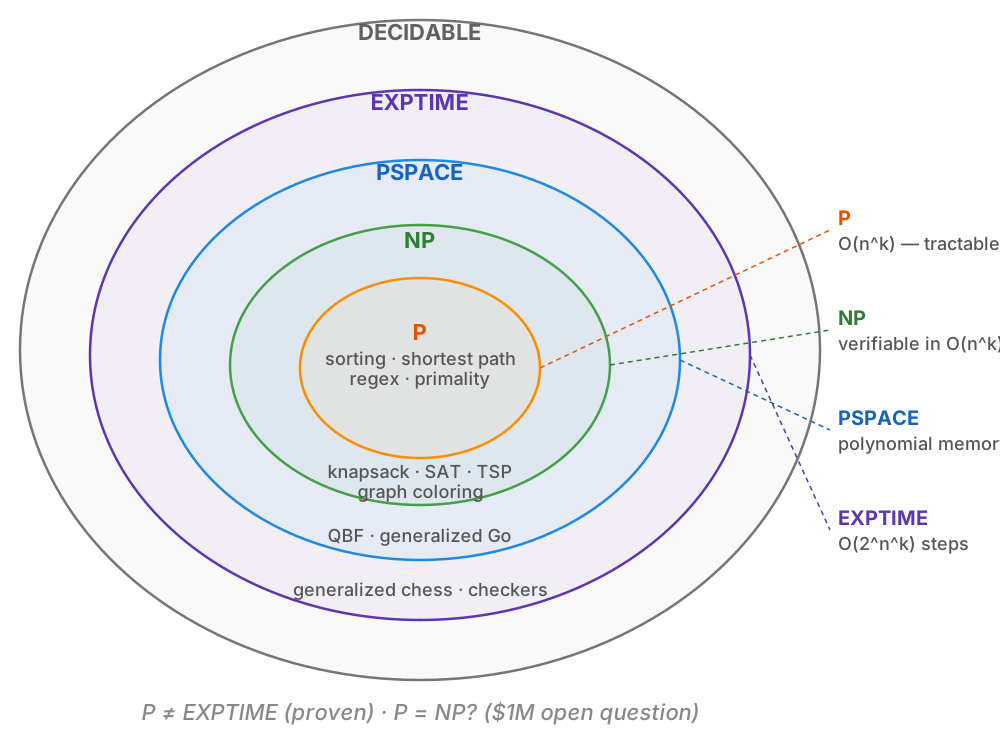
We know $P \neq EXPTIME$. But whether $P = NP$ is the biggest open question in computer science, worth a $1 million prize.
NP-Completeness
Some NP problems are the hardest problems in NP. These are called NP-complete: if you could solve any one of them in polynomial time, you would solve all of NP in polynomial time (and prove $P = NP$).
Stephen Cook (1971) and Leonid Levin (1973) proved that SAT (Boolean Satisfiability) is NP-complete. Richard Karp (1972) then showed 21 other problems are NP-complete by reducing them from SAT, the same reduction technique from Part 4, but now preserving polynomial time rather than decidability.
Today thousands of problems are known to be NP-complete. If anyone solves one of them efficiently, all of them fall. Nobody has, in over 50 years.
The Knapsack Problem
Here is one of those NP-complete problems, and it is something every engineer has faced intuitively.
You have a backpack with weight capacity $W$. There are $n$ items, each with a weight and a value. Pick items to maximize total value without exceeding the weight limit.
| Item | Weight | Value |
|---|---|---|
| Laptop | 3 | 4 |
| Camera | 2 | 3 |
| Book | 1 | 1 |
| Jacket | 2 | 2 |
With capacity $W = 4$: the best choice is Laptop + Book (weight 4, value 5).
Simple enough for 4 items. But with $n$ items, there are $2^n$ possible subsets to check. With 50 items, that is over one quadrillion subsets.
Java: Brute Force
The honest approach: try every subset.
public class KnapsackBruteForce {

    public static int solve(int[] weights, int[] values, int capacity) {
        int n = weights.length;
        int best = 0;

        for (int mask = 0; mask < (1 << n); mask++) {
            int totalWeight = 0, totalValue = 0;
            for (int i = 0; i < n; i++) {
                if ((mask & (1 << i)) != 0) {
                    totalWeight += weights[i];
                    totalValue += values[i];
                }
            }
            if (totalWeight <= capacity && totalValue > best) {
                best = totalValue;
            }
        }
        return best;
    }

    public static void main(String[] args) {
        int[] weights = {3, 2, 1, 2};
        int[] values  = {4, 3, 1, 2};
        System.out.println(solve(weights, values, 4)); // 5
    }
}
This is $O(2^n)$. It works for small $n$. At $n = 30$, it takes about a billion operations. At $n = 50$, you are waiting longer than the age of the universe.
Java: Dynamic Programming
The classic DP trick: build a table of “best value achievable with the first $i$ items and capacity $w$.”
public class KnapsackDP {

    public static int solve(int[] weights, int[] values, int capacity) {
        int n = weights.length;
        int[][] dp = new int[n + 1][capacity + 1];

        for (int i = 1; i <= n; i++) {
            for (int w = 0; w <= capacity; w++) {
                dp[i][w] = dp[i - 1][w];
                if (weights[i - 1] <= w) {
                    dp[i][w] = Math.max(dp[i][w],
                        dp[i - 1][w - weights[i - 1]] + values[i - 1]);
                }
            }
        }
        return dp[n][capacity];
    }

    public static void main(String[] args) {
        int[] weights = {3, 2, 1, 2};
        int[] values  = {4, 3, 1, 2};
        System.out.println(solve(weights, values, 4)); // 5
    }
}
This runs in $O(n \cdot W)$. Looks polynomial. But it is not.
The input size of $W$ is $\log_2 W$ bits. So $O(n \cdot W)$ is actually $O(n \cdot 2^{\text{bits of } W})$, exponential in the input size. This is called pseudo-polynomial: polynomial in the numeric value of the input, not in the length of the input.
If $W = 1{,}000$, the DP table has $1{,}000 \cdot n$ cells. Fast. If $W = 2^{64}$, the DP table does not fit in any computer on Earth.
This is why the DP solution does not prove $P = NP$.
The Practical Engineer’s Response to Intractability
In Part 4, we saw engineers respond to undecidability with timeouts, probes, and heuristics. The response to intractability is similar: give up on perfect, embrace good enough.
| Strategy | Idea | Example |
|---|---|---|
| Approximation | Get within a proven bound of optimal | Greedy knapsack (sort by value/weight ratio) |
| Heuristics | Use rules of thumb that usually work | Bin packing in Kubernetes |
| Restrict the input | Limit problem size so brute force is fine | Capacity planning with small $n$ |
| Randomized algorithms | Accept a small probability of being wrong | Randomized SAT solvers |
| Parallelism | Throw more machines at it | MapReduce over subsets |
The pattern is the same as with undecidability: know the theoretical limit, then choose a practical trade-off.
The Full Picture
We can now place everything on one map:
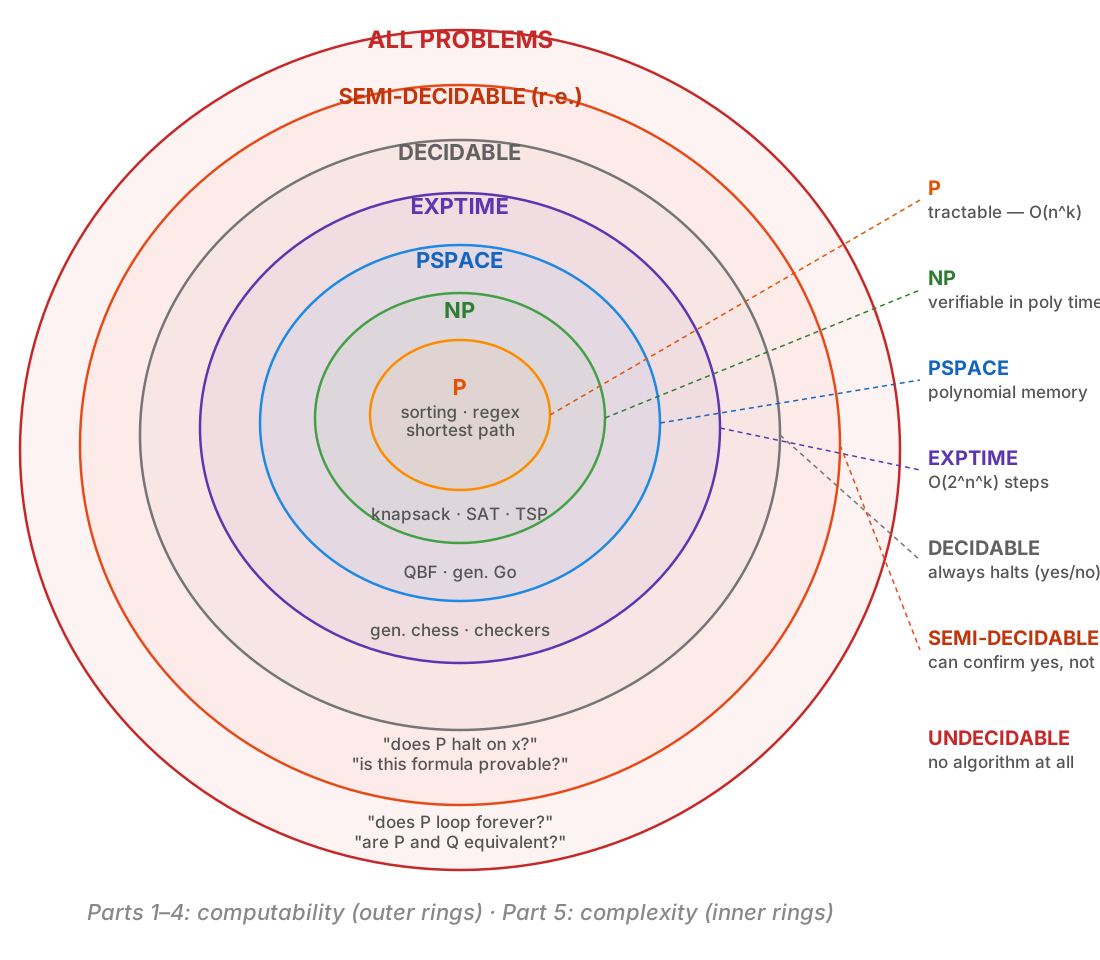
Parts 1-4 zoomed from the innermost circle outward, through the Chomsky hierarchy. Part 5 zoomed into the decidable region and found that it too has structure: an onion of complexity classes, each one exponentially harder than the last.
The takeaway for engineers?
Know where your problem lives. A problem in P gets a clean algorithm. A problem in NP-complete gets a heuristic. An undecidable problem gets a timeout and a prayer.
And the next time someone asks “why can’t the computer just figure out the optimal schedule?” you will know: it probably can, but not before the heat death of the universe :D.
That wraps up the Computability Theory series! From regex to the limits of computation, we have seen the full spectrum.
Stay curious, and … until next time!